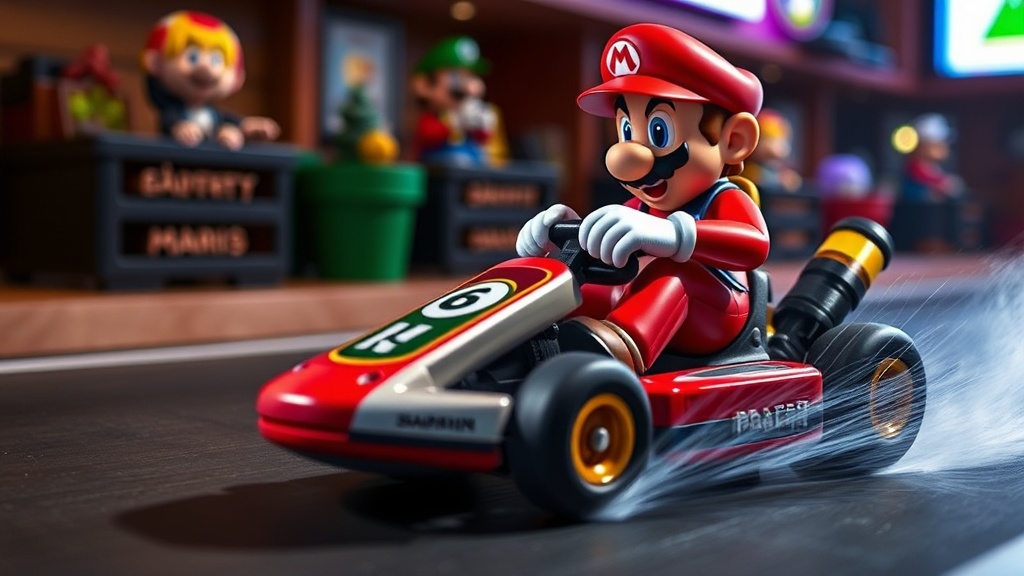
The Unspoken Truth About Mario Kart Collectible Values

It’s easy to look at an old Mario Kart toy, perhaps a dusty die-cast from the 90s or a faded plush from a forgotten promotion, and assume it holds significant value. The allure of nostalgia often warps our perception, leading many to believe that simply being "old" automatically equates to "valuable." This common misconception leads to disappointment, as many cherished items, while rich in personal history, simply don't command high prices on the secondary market. But is your cherished collection a genuine treasure trove of appreciating assets, or mostly a monument to fond memories that will, financially speaking, stay at face value? This post will pull back the curtain on the often-opaque Mario Kart collectible market, exploring the true drivers of value beyond mere sentimentality. We’ll delve into discerning real market worth, understanding subtle but powerful market trends, and mapping out a strategic approach to collecting that aims to build a portfolio of items likely to retain—and potentially increase—their worth, rather than just taking up ever-more-limited shelf space.
What truly makes a Mario Kart collectible valuable in today's market?
Value in the Mario Kart collecting sphere, much like any specialized hobby, doesn’t simply materialize with age; it boils down to a complex confluence of factors. Rarity, for instance, plays an immense, often decisive, role. Think about items stemming from genuinely limited production runs—pieces released only in specific geographic regions, for extremely short windows, or as exclusive promotional tie-ins. A Japanese-exclusive promotional item for Mario Kart 64, perhaps a miniature trophy given solely to tournament winners at a specific event in 1997, naturally possesses a far higher rarity quotient than a mass-market toy available globally for years in countless toy aisles. Understanding an item’s original distribution scope and its quantifiable scarcity is frequently the first, most illuminating step in assessing its inherent worth. Did it come from a cereal box in 1992, or was it a hand-painted prototype gifted to a development team member? The stories behind these items are critical.
Condition follows closely behind rarity, often making or breaking an item’s market appeal. A pristine, unopened package (often abbreviated as NIB, for New In Box, or MOC, Mint On Card) commands a dramatically higher price—sometimes tenfold or more—than a loose, played-with counterpart. Collectors obsess over minute details: razor-sharp corners on cardbacks, uncreased blister bubbles, and factory-sealed boxes that show no sign of tampering. This isn't just arbitrary pickiness; it’s about preserving an item in its original, untouched state, a tangible link to its manufacturing moment, capturing a slice of time. Professional grading services, like those found at AFA (Action Figure Authority) for toys or CGC (Certified Guaranty Company) for comics, exist precisely to standardize this evaluation. They provide objective, third-party assessments of condition and authenticity, which significantly builds buyer confidence and facilitates fair pricing on the secondary market. If you’re serious about investing, understanding grading scales is non-negotiable.
Then there’s demand, a more mercurial factor that can be fickle but is always deeply influenced by enduring character popularity and the sustained relevance of specific games. Iconic characters like Mario, Luigi, and Bowser are evergreen, always retaining a baseline of appeal. Yet, sometimes a less prominent character, perhaps a Wiggler or a Shy Guy, sees an unexpected surge in popularity due to a recent game appearance, a viral moment, or even a compelling fan theory. This sudden spotlight can temporarily—or even permanently—drive up the desire and price for their older, perhaps previously overlooked, merchandise. Furthermore, the lasting cultural impact and perceived quality of specific game titles often ripple directly into the collectible market. Items intrinsically tied to landmark, generation-defining releases like Super Mario Kart (the original spark), Mario Kart 64 (the 3D revolution), or the incredibly successful Mario Kart 8 Deluxe often maintain exceptionally robust demand and prices years after their debut, reflecting their indelible place in gaming history.
For more detailed information on collectible grading and its impact on value, check out